















Medically Reviewed by: Alyssa DeStefano, LCSW, Licensed Clinical Social Worker | Revolution Recovery Center Intensive Outpatient Program Guide
One of the biggest concerns that arises when seeking treatment is how you can keep your job when you return to employment. You are not alone in this thought, as many people are unsure about what will happen to their job while they are in an Intensive Outpatient Program (IOP) facility. Bills do not stop accruing while you are getting better, and the thought of losing your identity at work is also difficult to imagine.
The good news is that most people do continue to work while attending IOP. The Intensive outpatient program therapy is designed with this idea in mind, so if you make an appropriate plan before beginning treatment, communicate honestly, and develop a treatment schedule around your life rather than creating your life around the treatment schedule you will be able to continue working during treatment.
So here in this blog, we give you proper information about can you work while attending an intensive outpatient program. So, stay tuned for this blog.
What Is an Intensive Outpatient Program, Exactly?

An Intensive Outpatient Program (IOP) is a structured form of addiction and mental health treatment that allows clients to continue living at home and maintain daily routines, such as work, school, or caregiving while still receiving multiple hours of clinical support every week. IOP does not require clients to stay overnight at the treatment facility like a residential or inpatient program; clients participate in individual counselling, group therapy, psychoeducation, and sometimes family therapy for a designated number of hours on several designated days each week.
IOP is situated in the middle of the treatment continuum; less intensive than a PHP, and more structured than a traditional weekly outpatient program. Because IOP provides clients with the benefits of a higher level of care, clients may not have to leave their work, school, or family commitments completely to obtain the clinical structure.
Levels of Care Compared
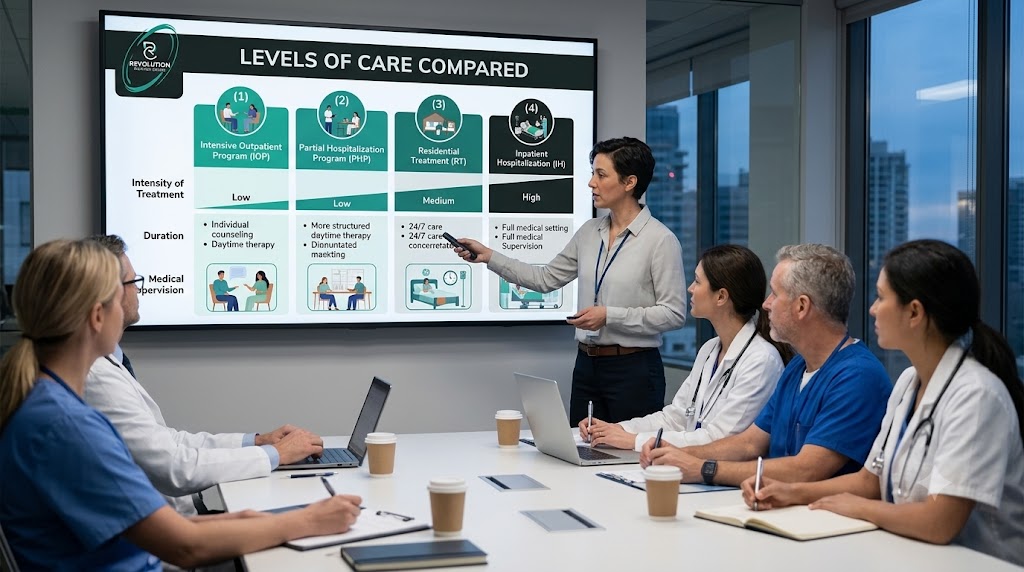
| Level of Care | Typical Weekly Hours | Life at Home? | Can Work or Attend School? |
| Residential Inpatient | 24/7 supervised care | No | No |
| Partial Hospitalization | 20 to 30 hours | Usually yes | Rarely, due to daytime hours |
| Intensive Outpatient | 9 to 15 hours | Yes | Often, yes |
| Standard Outpatient | 1 to 3 hours | Yes | Yes |
As the table shows, IOP is specifically designed to sit at a point where clinical intensity and real-world responsibility can coexist.
Can You Really Work During IOP? The Short Answer
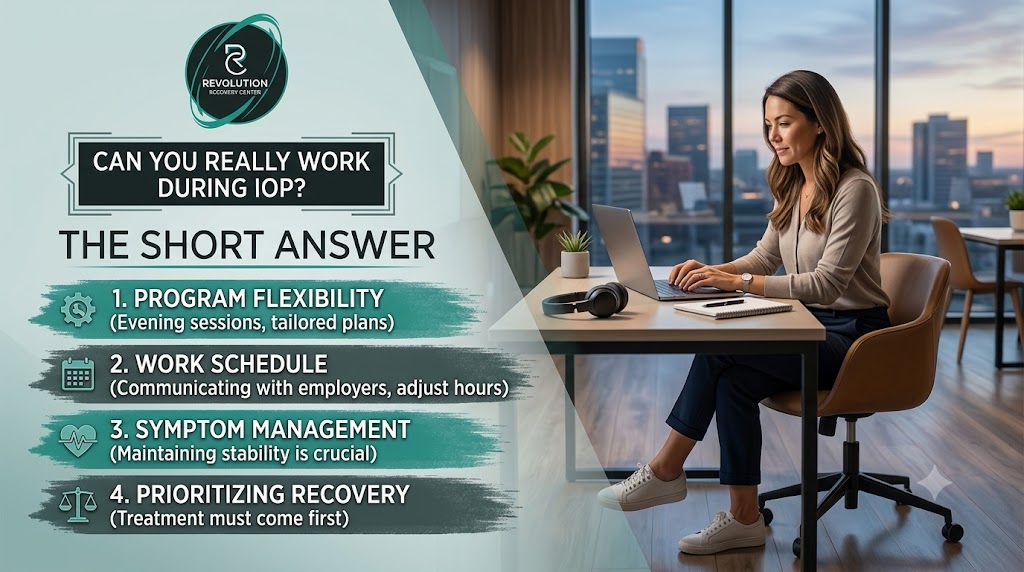
Yes, working while in IOP is definitely a possibility. IOP schedules are designed for flexibility so that clients can continue to work or attend school while also attending IOP. Most IOPs have a block of time from 3-4 hours three (3) to 5 times a week usually in the morning, afternoon or evening. Therefore, this setup allows participants to balance their work schedules with the IOP schedule since recovery will benefit the participant if they incorporate it into their daily lives vs. stopping everything in their life to participate fully in IOP.
With all of this being said, there is a difference between “can you work” while attending IOP and “should you work” full time while attending IOP. Early stages of recovery are going to take a lot out of you both emotionally and physically. Even though you may be able to handle a full time work week plus IOP, it is important to be honest with yourself about your physical and emotional ability to handle work along with IOP and if taking a break for a short period of time would help you recover better and help you perform your job better in the long term.
Typical Weekly Time Commitment
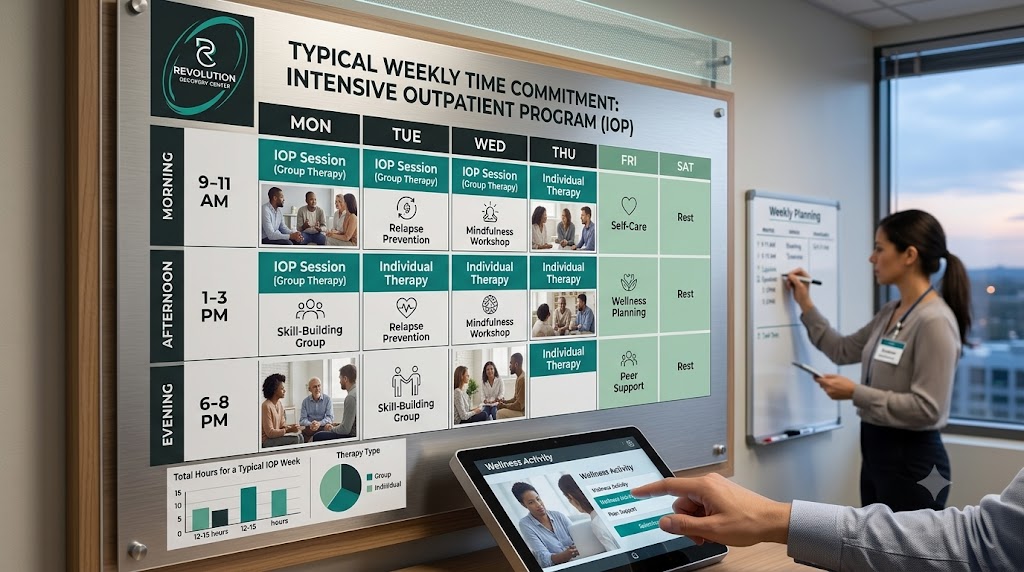
The following outline is a general idea of what an IOP month might consist of based on working a standard (same hours every week) job:
| Day | IOP Session | Typical Work Schedule |
| Monday | 6:00 PM to 9:00 PM | 9:00 AM to 5:00 PM |
| Tuesday | 6:00 PM to 9:00 PM | 9:00 AM to 5:00 PM |
| Wednesday | Off | 9:00 AM to 5:00 PM |
| Thursday | 6:00 PM to 9:00 PM | 9:00 AM to 5:00 PM |
| Friday | Off | 9:00 AM to 5:00 PM |
Note: Scheduled treatment options are tailored to suit individual clients’ needs based on treatment settings/centers and will differ accordingly. As such, morning programs and daytime outpatient programs may also be available to accommodate clients who need to work in the evenings or work night shifts — if their certain clinical needs are met by those providers.
Legal Protections That May Help You Balance Work and Treatment

When inquiring about job security while undergoing treatment, several Federal laws are often referenced:
- Family & Medical Leave Act (FMLA) allows an eligible employee who works for a qualifying employer to take 12 weeks of unpaid job-protected leave to address a qualifying health condition, including times when being treated for a substance use disorder or mental health condition.
- Americans with Disabilities Act (ADA) provides protections against discrimination for someone who is recovering from a substance use disorder, however, it does not protect against discrimination for someone who is currently using illegal drugs.
Determining whether you are eligible under either act is based upon your employer’s size, your date of hire, and your hours of service. Prior to disclosing any information to an employer regarding your eligibility under these two laws, you should confer with an admissions or HR-knowledgeable individual who is also familiar with your individual circumstances.
How People Typically Approach Work During IOP

| Approach | Description | Best Suited For |
| Full-time work + evening IOP | Standard job hours, treatment after work | Stable job, flexible IOP evening track |
| Reduced hours + daytime IOP | Part-time work or reduced schedule | Higher clinical need, physically demanding jobs |
| FMLA leave + PHP or IOP | Formal leave while attending more intensive care | Acute symptoms, unstable home environment |
| Remote/hybrid work + IOP | Working from home around session times | Desk jobs, flexible employees |
Signs Your Work Schedule May Need to Change

A lot of individuals are good at balancing two responsibilities; however when you are seeing one or more of these signs, it may be time to have a talk with your care team regarding adjusting your schedule:
- Chronic fatigue or trouble concentrating at work
- Missing sessions because you are busy meeting work deadlines
- Feeling increased cravings/emotionally reactive due to the stress from your schedule
- Considering that treatment is just something done rather than really being involved in the entire process
- Seeing tunnels in at work with no actual or true results
None of these may indicate that your treatment has failed, but more so that your treatment plan needs to be adjusted. The person does not need to be changed or fail; rather the treatment plan for them needs adjustment based on their present condition and situation.
Frequently Asked Questions
1. Will my employer know I’m in treatment?
Unless you decide to inform them of it, there is no requirement for you to disclose this information to your employer or to your colleagues, unless you submit a formal request for FMLA leave in writing with the appropriate documentation. Most people refer to their appointments as “going to the doctor.”
2. How many hours a week is IOP, typically?
Therapy sessions in Intensive Outpatient Treatment Program (IOP) vary from center to center and reflect the client’s clinical needs; however, IOP generally provides 9 to 15 hours of individual and/or group sessions per week, divided over 3-5 days of treatment based on the above configurations.
3. Can I choose morning, afternoon, or evening sessions?
The Revolution Recovery Center and other programs have multiple types of scheduling so that clients are able to continue working, going to school and/or providing care to others while they are in the program.
4. Is IOP less effective than inpatient treatment because I keep working?
No, that’s still not always true – studies of outpatient care show good effectiveness among many patients who are stable (i.e., living in a secure/home situation), at a low risk for serious medical issues, and receiving some other type of supportive environment. The clinical assessment will tell you the right level of care for each individual based on the clinical needs.
5. What if my job requires overnight shifts or travel?
It is advisable to reach out to the admissions department about this option, as some programs may allow for alterable timeframes; but, in other cases, short time off and/or temporary work arrangements may aid the applicant during the initial stage of recovery.
6. Can I be fired for attending an IOP?
Employment protections vary. FMLA and ADA may offer protection depending on your employer size, tenure, and how the situation is handled. It’s worth speaking with HR or an employment resource before disclosing details.
7. Does insurance cover IOP treatment?
The majority of large insurance providers include coverage for IOP treatment as part of their overall policy. However, each insurance policy has different coverage amounts and specifications, so verifying your benefit before starting would be a good idea.
8. How long does someone typically stay in an IOP?
The length of an IOP will depend on the individual, but on average the clinical programs last anywhere from several weeks to a couple of months based upon both the clinical progress and treatment expectations of the person receiving care within that program.
Finding a Program That Fits Your Life
This means that balancing work schedule(s) and recovery/treatment is about developing a plan that is creative enough to create flexible day(s) and times. An IOP program should be structured in such a way that there is no decision between keeping your paycheck or continuing with your treatment and recovery. IOP programs that provide flexible scheduling, good communication with clinicians and realistic goals of success will allow individuals to be successful at work (full, part or very demanding jobs) while they continue to work towards becoming healthy through treatment/recovery.
Revolution Recovery Center offers Intensive Outpatient Treatment across 2 states, Florida and New Jersey, that includes flexible schedule options, enabling you to pursue your recovery process without having to stop job(s), homes/families, or responsibilities. If you are considering how to develop a plan that works with IOP, please contact the admissions team at Revolution Recovery Center for more information.
Contact Revolution Recovery Center
Phone: (855) 599-2929
Florida Location: 415 Federal Hwy, Boynton Beach, FL 33435 — (866) 427-5690
New Jersey Location: 1035 N Black Horse Pike, Suite 8, Williamstown, NJ 08094 — (856) 758-2498
Verify Your Insurance: Check your coverage here
Contact Us: Reach out to our admissions team